Archives
Categories
PCL Injury and Reconstruction Surgery

Restore Knee Stability. Regain Strength. Return to an Active Life.
Posterior Cruciate Ligament (PCL) reconstruction is a surgical procedure performed to restore knee stability following a significant injury to the PCL, one of the major ligaments responsible for maintaining normal knee movement and function.
PCL injuries commonly occur following sports related trauma, road traffic accidents, falls, or direct impact to a bent knee. Patients may experience pain, swelling, instability, difficulty walking, or reduced confidence during physical activities.
While many isolated PCL injuries can be managed successfully without surgery, reconstruction may be recommended for patients with persistent instability, severe ligament injuries, or associated damage to other knee structures.
Treatment focuses on restoring knee stability, protecting the surrounding joint structures, and helping patients return to their everyday activities and sports safely.
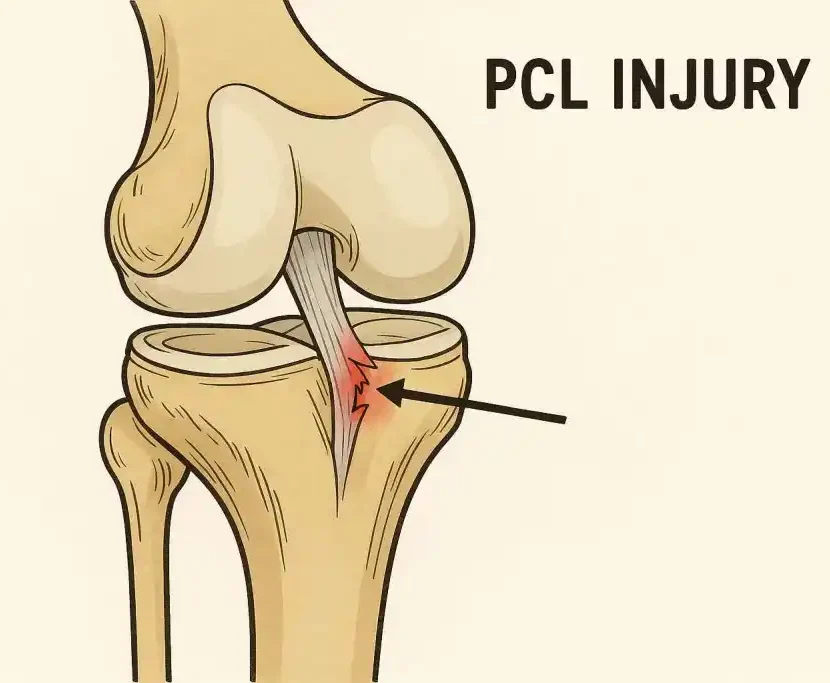
What Is the Posterior Cruciate Ligament (PCL)?
The Posterior Cruciate Ligament (PCL) is one of the four major ligaments that stabilise the knee. It connects the thighbone (femur) to the shinbone (tibia) and lies behind the Anterior Cruciate Ligament (ACL). Its primary function is to prevent the shinbone from moving excessively backwards relative to the thighbone, particularly when the knee is bent .The PCL also contributes to rotational stability and coordinated knee movement during walking, running, climbing stairs, and sporting activities.
When the PCL is injured, the knee may develop excessive backward movement of the tibia, known as posterior instability. This can affect normal knee mechanics and, in some patients, place additional stress on the surrounding cartilage and joint structures.
What Causes a PCL Injury?
PCL injuries generally result from significant force applied to the knee, particularly when it is bent.
Common causes include:
Sports Injuries: Falls onto a bent knee, direct contact, sudden twisting movements, or hyperextension injuries during activities such as football, rugby, basketball, or other sports.
Road Traffic Accidents: A direct impact to the front of a bent knee, such as the shin striking a vehicle dashboard, can force the tibia backwards and injure the PCL.
Falls and Direct Trauma: Falling directly onto a flexed knee or sustaining a forceful blow can cause partial or complete ligament tears.
Knee Dislocations: High-energy injuries may damage the PCL along with the ACL, collateral ligaments, and other stabilising structures.
Multiligament Knee Injuries: PCL tears may occur alongside injuries to the posterolateral corner (PLC), medial collateral ligament (MCL), or other knee structures.
PCL injuries may occur in isolation or as part of a more complex knee injury. Identifying associated ligament, cartilage, or meniscal damage is essential for appropriate treatment planning.
What Are the Symptoms of a PCL Injury?
The symptoms depend on the severity of the injury and whether other knee structures are involved.
Common symptoms include:
- Pain and swelling following a knee injury.
- Difficulty walking or bearing weight.
- Knee stiffness and restricted movement.
- A sensation that the knee is unstable or giving way.
- Difficulty walking downhill or descending stairs.
- Discomfort during squatting, running, or sports.
- Reduced confidence during sudden movements.
- Persistent pain or instability following an earlier injury.
Unlike ACL injuries, some isolated PCL tears may produce relatively mild symptoms initially. Patients may continue walking despite significant ligament damage. Persistent pain, instability, or difficulty returning to normal activities following a knee injury should be evaluated by an orthopaedic surgeon.
A high-energy injury associated with severe deformity, a cold or numb foot, or difficulty moving the foot requires emergency assessment because blood vessel or nerve injuries may be present.
How Is a PCL Injury Diagnosed?
A detailed clinical examination, supported by appropriate imaging, helps determine the severity of the injury and identify associated knee damage.
- Clinical Examination : Your surgeon evaluates knee movement, swelling, posterior stability, ligament integrity, and overall joint function. Specific clinical tests, including the posterior drawer test and posterior sag assessment, help identify excessive backward movement of the tibia.
- X-rays : X-rays help identify fractures, bony avulsion injuries, and abnormalities in knee alignment. Specialised stress X-rays may be used to measure posterior tibial displacement and assess the severity of instability.
- MRI Scan : MRI is useful for evaluating the PCL, identifying partial or complete tears, and detecting associated ACL, collateral ligament, meniscal, cartilage, or posterolateral corner injuries.
- CT Scan : In selected cases, CT imaging may be required to assess bony avulsion fractures or complex injuries. The aim is not simply to identify a PCL tear, but to understand the severity of instability and determine whether other structures require treatment.
Can a PCL Tear Heal Without Surgery?
Yes. Unlike some other knee ligament injuries, many isolated PCL tears have the potential to heal and can be managed successfully without surgical reconstruction.
Non-surgical management is often considered for isolated Grade I and II injuries, as well as selected complete tears without significant functional instability.
Treatment may include:
Pain and Swelling Management: Ice, appropriate medication, compression, elevation, and temporary modification of activities.
PCL-Specific Bracing: A specialised knee brace may help support the tibia and reduce excessive backward movement during ligament healing.
Protected Walking: Crutches or temporary weight-bearing restrictions may be recommended during the initial recovery period.
Physiotherapy: Guided exercises help restore knee movement, improve muscle strength, and regain functional stability.
Quadriceps Strengthening: Strengthening the muscles at the front of the thigh is particularly important because they help support the knee and counter posterior tibial displacement.
Balance and Functional Training: Progressive exercises help restore walking mechanics, coordination, and confidence.
Patients are monitored throughout rehabilitation to assess stability, symptoms, and functional recovery.
Your surgeon will determine whether non surgical treatment is appropriate based on the injury pattern, degree of instability, associated injuries, and your individual activity requirements.
When Is PCL Reconstruction Recommended?
Surgery may be considered when a significant PCL injury causes persistent instability, affects everyday activities, or occurs alongside other major ligament injuries.
Common indications include:
- Persistent knee instability despite appropriate rehabilitation.
- Severe PCL deficiency with significant functional limitations.
- Chronic PCL injuries causing symptomatic posterior instability.
- Multiligament injuries involving the PCL and ACL or collateral ligaments.
- Combined PCL and posterolateral corner injuries.
- Selected high-demand athletes with symptomatic instability.
- Certain displaced PCL avulsion fractures requiring surgical fixation.
- Associated injuries requiring surgical treatment.
In multiligament injuries, reconstruction of the PCL may need to be combined with treatment of other damaged structures to restore overall knee stability.
The decision to operate is based on the patient’s symptoms, clinical examination, functional requirements, and associated injuries rather than the MRI findings alone.
Restore Knee Stability After PCL Injury
A PCL injury can affect knee stability, movement, and your ability to stay active. Consult Dr. Dhruva Angachekar, an experienced orthopaedic surgeon in Mumbai, for expert assessment and personalised guidance on PCL reconstruction and rehabilitation.
What Is PCL Reconstruction Surgery?
PCL reconstruction involves replacing the damaged or non-functional ligament with a tendon graft to restore posterior knee stability.
The procedure is generally performed using arthroscopic techniques, where a camera and specialised instruments are introduced through small incisions around the knee.
Graft Selection
The reconstructed ligament may be created using:
- Autograft: Tendon tissue obtained from the patient’s own body, such as the quadriceps, hamstring, or patellar tendon, depending on the procedure.
Allograft: Suitable donor tendon tissue used in selected cases.
Your surgeon will discuss graft selection based on your age, activity requirements, associated injuries, graft availability, and surgical considerations.
Reconstruction Techniques
PCL reconstruction may be performed using a single-bundle or double-bundle technique, depending on the injury pattern and surgical assessment.
Both aim to restore ligament function and posterior knee stability. The choice of technique depends on the individual patient’s anatomy, associated injuries, and the surgeon’s assessment.
In certain cases, a bony avulsion of the PCL may be treated by fixing the detached bone fragment rather than reconstructing the entire ligament.
How Is PCL Reconstruction Performed?
PCL reconstruction generally involves the following stages.
- Preoperative Evaluation : Your surgeon assesses your symptoms, clinical stability, ligament condition, knee movement, and imaging findings.
Associated injuries involving the ACL, collateral ligaments, posterolateral corner, meniscus, or cartilage are identified and incorporated into the treatment plan.
- Surgical Planning and Graft Selection : The surgeon plans the reconstruction technique, selects an appropriate tendon graft, and determines whether additional ligament or cartilage procedures are required.
- Arthroscopic Assessment : A camera is introduced into the knee through small incisions to evaluate the joint structures and confirm the extent of injury.
Associated meniscal or cartilage injuries may be treated when indicated.
- Preparation and Placement of the Graft : The damaged ligament is assessed, and the graft is positioned along the intended anatomical course of the native PCL using appropriate surgical techniques.
- Graft Fixation : The graft is secured using specialised fixation devices. The surgeon assesses graft tension, knee movement, and posterior stability to ensure appropriate reconstruction.
- Treatment of Associated Injuries : Additional ligament reconstruction, meniscal repair, or cartilage procedures may be performed during the same operation when required.
- Postoperative Care : Following surgery, patients receive appropriate pain management, wound care, bracing, and walking instructions.
A structured rehabilitation programme is initiated to protect the reconstructed ligament while gradually restoring movement and muscle function.
What Happens After PCL Reconstruction?
Recovery after PCL reconstruction requires careful protection of the graft during the initial healing period.
Unlike ACL rehabilitation, PCL rehabilitation places particular emphasis on preventing excessive backward movement of the tibia and avoiding exercises that place unnecessary stress on the healing graft.
Most patients begin appropriate mobilisation shortly after surgery, although the amount of weight permitted on the operated leg varies according to the procedure and associated injuries.
A specialised PCL brace may be recommended for several weeks or months to support the knee and protect the reconstruction. Patients gradually regain walking ability, knee movement, muscle strength, and functional independence through structured physiotherapy.
Return to competitive sports commonly requires 9–12 months or longer, particularly following combined ligament reconstruction or complex knee injuries.
Rehabilitation After PCL Reconstruction
A structured rehabilitation programme is essential for protecting the reconstructed ligament, restoring knee mobility, rebuilding muscle strength, and safely returning to everyday activities and sports.
Rehabilitation differs from ACL reconstruction because the PCL must be protected from excessive posterior tibial translation during healing.
Your surgeon and physiotherapist will guide the progression according to your procedure and recovery.
Phase 1: Early Recovery (Weeks 0–2)
The initial phase focuses on protecting the reconstructed ligament, controlling pain and swelling, and beginning safe mobilisation.
Rehabilitation goals include :
- Reducing pain and postoperative swelling.
- Protecting the reconstructed ligament using a prescribed knee brace.
- Beginning walking with crutches according to weight-bearing instructions.
- Restoring full knee extension and initiating controlled knee bending.
- Activating the quadriceps muscles through guided exercises.
- Preventing excessive backward movement of the tibia.
During this phase, active hamstring exercises and movements that place excessive stress on the PCL graft are generally avoided.
Phase 2: Protected Movement and Early Strengthening (Weeks 2–6)
Rehabilitation focuses on gradually improving knee movement while maintaining protection of the reconstruction.
Activities may include:
- Controlled knee range-of-motion exercises.
- Progressive quadriceps strengthening.
- Gentle hip and core strengthening.
- Patellar mobilisation and swelling management.
- Gradual improvement in walking mechanics.
- Balance exercises within the prescribed restrictions.
Walking aids and bracing are continued or modified according to the surgeon’s instructions.
The priority is to restore movement and muscle control without placing excessive tension on the healing graft.
Phase 3: Strengthening and Functional Recovery (Weeks 6–12)
As healing progresses, rehabilitation focuses on improving muscle strength, knee control, and functional independence.
Exercises may include:
- Progressive quadriceps strengthening.
- Supported squats and controlled leg-press exercises within permitted ranges.
- Balance and proprioception training.
- Stationary cycling when adequate knee movement has been achieved.
- Hip and core strengthening.
- Progressive walking and functional exercises.
Resisted hamstring strengthening may remain restricted during this period, depending on the reconstruction technique and rehabilitation protocol.
The goal is to improve knee stability and strength while protecting the graft during biological healing.
Phase 4: Advanced Strengthening (Months 3–5)
Rehabilitation progresses towards more demanding strengthening and functional exercises.
Training may include:
- Progressive resistance exercises.
- Single-leg strengthening and balance training.
- Functional movement and coordination exercises.
- Stationary cycling and suitable low-impact cardiovascular activities.
- Gradual introduction of hamstring strengthening when permitted.
- Progressive endurance and neuromuscular training.
Running may be considered around 5–6 months or later, depending on knee stability, quadriceps strength, movement quality, and the surgeon’s assessment.
Not every patient will be ready to begin running at this stage.
Phase 5: Return to Running and Sports Training (Months 5–9)
As knee strength, stability, and confidence improve, rehabilitation progresses towards sports-related movements.
Activities may include:
- Structured running progression.
- Controlled jumping and landing exercises.
- Advanced quadriceps and lower-limb strengthening.
- Balance and single-leg control exercises.
- Agility and change-of-direction training.
- Progressive sports-specific drills.
Selected athletes may begin supervised sports training from approximately six months, provided appropriate functional milestones have been achieved.
Participation in sports training does not necessarily mean the knee is ready for unrestricted competitive activity.
Phase 6: Return to Competitive Sports (Months 9–12 and Beyond)
The final phase focuses on restoring the strength, stability, coordination, and confidence required for competitive sports.
Before returning, your surgeon and rehabilitation team may assess:
- Full or near-full, pain-free knee movement.
- Absence of significant swelling or instability.
- Quadriceps and hamstring strength.
- Functional strength compared with the opposite limb.
- Balance, hopping, and movement-control tests.
- Running, jumping, and change-of-direction mechanics.
- Completion of sports-specific rehabilitation.
- Psychological readiness and confidence.
Return to competitive sports generally takes 9 12 months or longer, particularly for high demand sports involving pivoting, jumping, or physical contact.
Your surgeon will assess your functional recovery and guide a gradual return to sporting activities.
Important Rehabilitation Precautions
Following PCL reconstruction, certain precautions may be recommended to protect the healing graft:
- Use the prescribed PCL brace as instructed.
- Follow the recommended weight-bearing restrictions.
- Avoid unsupported or aggressive knee bending during early recovery.
- Delay resisted hamstring exercises until permitted.
- Avoid premature running, jumping, pivoting, or contact sports.
- Progress strengthening and sporting activities under professional supervision.
Patients undergoing additional meniscal repair, cartilage procedures, or multiligament reconstruction may require longer periods of protection and a modified rehabilitation programme.
“All rehabilitation timelines are approximate. Progression should be guided by healing, clinical assessment, knee stability, and functional performance rather than time alone.”
When Can I Return to Work and Everyday Activities?
Return to work depends on the surgical procedure, occupation, mobility, and rehabilitation progress.
- Desk-Based Work: Some patients may return to sedentary work within approximately 2–6 weeks, depending on comfort, swelling, mobility, and any bracing or weight-bearing restrictions.
- Physically Demanding Work: Jobs involving prolonged standing, heavy lifting, squatting, climbing, or manual labour may require several months before unrestricted duties can be resumed.
- Driving: Driving can be resumed when adequate knee control has returned, movement restrictions permit safe vehicle operation, and the patient can perform an emergency stop without difficulty. Clearance from the treating surgeon is important.
Your surgeon will guide your return to work based on your functional recovery and occupational requirements.
Benefits of PCL Reconstruction
For appropriately selected patients, PCL reconstruction may provide:
- Improved posterior knee stability.
- Reduced episodes of giving way or instability.
- Improved confidence during walking and physical activities.
- Improved ability to perform daily activities and sports.
- Restoration of more normal knee mechanics.
- Improved functional strength and movement control.
- Treatment of associated ligament injuries when required.
The primary objective is to restore knee stability and function while protecting the natural joint structures.
Outcomes vary between patients, and surgery cannot guarantee complete restoration of knee stability, elimination of pain, or prevention of future arthritis.
Are There Any Risks Associated With PCL Reconstruction?
As with any orthopaedic surgical procedure, PCL reconstruction carries certain risks.
Potential complications include:
- Infection or wound complications.
- Blood clots.
- Persistent pain or swelling.
- Knee stiffness or restricted movement.
- Residual posterior instability.
- Graft stretching, loosening, or failure.
- Complications related to graft harvesting or fixation.
- Nerve or blood vessel injury.
- Need for further surgery in selected cases.
Because the PCL lies close to important blood vessels and nerves behind the knee, careful surgical planning and technique are particularly important. Your surgeon will discuss the potential benefits, risks, and expected outcomes before recommending reconstruction.
Is PCL Reconstruction Right for Everyone?
Not every patient with a PCL tear requires surgery. The decision depends on several factors, including:
- Severity and location of the ligament injury.
- Degree of posterior knee instability.
- Whether the injury is isolated or involves multiple ligaments.
- Associated meniscal or cartilage damage.
- Symptoms and functional limitations.
- Response to bracing and physiotherapy.
- Age and activity requirements.
- Sporting and occupational demands.
- Overall health and treatment expectations.
A detailed orthopaedic evaluation helps determine whether structured rehabilitation, surgical reconstruction, or another treatment approach is most appropriate.
Hear From Our Happy Patients
Read genuine patient experiences and feedback about Dr. Dhruva Angachekar’s compassionate care, orthopedic expertise, and commitment to patient recovery.
EXCELLENT

Based on 6 reviews

Posted on Google 

Smita Bhate
Trustindex verifies that the original source of the review is Google. Dr. Dhruva Angachekar helped me resolve a few chronic issues I suffered , pain and restriction in movement and some regular activities.
My shoulder blade had stabbing pain , my glute was very painful and hip mobility was compromised, some knee pain too.
He assessed my overall mobility, condition and put me onto a specialised sports performance physiotherapist, to realign my kinetic chain , as he had explained to me.
It took some months of rehabilitation, but for the 1st time , I got relief without medication and my mobility improved drastically and for good
I was extremely happy for the specific recommendations he had advised the sports physiotherapist about, which eventually resolved so many simultaneous issues .
I highly recommend him as an Orthopaedic doctor for Sports Injury and he is a Joint Replacement specialist too.
Posted on Google

pradnya jadhav
Trustindex verifies that the original source of the review is Google. Excellent experience ! Had visited Dr. Dhruv for knee pain and a possible hand fracture! Guided us well through the treatment.
Posted on Google

Prabhash Singh
Trustindex verifies that the original source of the review is Google. Dr Dhruva Angachekar recommended for best orthopedic and sports injury surgeon in Mumbai.
Posted on Google

Antesh Anand
Trustindex verifies that the original source of the review is Google. Highly recommended orthopedic and sports injury surgeon in Mumbai
Frequently Asked Questions
Yes. Many isolated PCL injuries can heal or recover satisfactory function without surgery, particularly when treated with appropriate bracing and structured rehabilitation. Even some complete isolated tears may be managed non-surgically if the knee remains functionally stable. Your surgeon will assess the injury severity, knee stability, and activity requirements before recommending treatment.
The ACL primarily prevents excessive forward movement of the shinbone, while the PCL prevents excessive backward movement. ACL injuries are commonly associated with twisting and pivoting movements, whereas PCL injuries often result from direct impact to a bent knee. Unlike many complete ACL tears, isolated PCL injuries have a greater potential to heal or become functionally stable without surgery.
PCL reconstruction is generally performed using arthroscopic techniques, involving a camera and specialised instruments inserted through small incisions around the knee. Additional incisions may be required for graft preparation, fixation, or treatment of associated ligament injuries. Your surgeon will explain the planned technique before surgery.
Most patients begin walking with crutches shortly after surgery, following the surgeon's instructions. A specialised PCL brace may be recommended, and weight-bearing may be restricted during the initial recovery period. Walking aids are gradually reduced as knee strength, control, and healing improve.
Recovery varies depending on the severity of the injury, reconstruction technique, and associated procedures.
Many patients gradually resume routine daily activities over the first several weeks, while strengthening and functional recovery continue for several months.
Return to competitive sports commonly requires approximately 9–12 months or longer, depending on individual recovery and functional assessment.
Yes. In patients with combined ACL and PCL injuries, both ligaments may require reconstruction to restore knee stability.
Additional injuries involving the collateral ligaments or posterolateral corner may also need treatment.
These procedures require detailed planning and individualised rehabilitation, with recovery often taking longer than after isolated ligament reconstruction.
Some isolated PCL injuries recover satisfactorily without surgery.
However, persistent PCL deficiency can cause ongoing instability, altered knee mechanics, pain, and functional limitations. In some patients, chronic instability may contribute to progressive cartilage damage and arthritis.
Not every untreated PCL tear causes long-term problems, but persistent symptoms should be evaluated by an orthopaedic surgeon.
Many patients can return to sporting activities following successful rehabilitation.
The timing depends on ligament healing, knee stability, muscle strength, functional testing, and the physical demands of the sport.
Competitive or high-demand sports generally require more extensive rehabilitation than routine daily activities.
Your surgeon will guide your return to sport based on functional recovery rather than time alone
Connect With Us
Email Address :
ortho.paramount@gmail.com
Location Address :
Laxmi Commercial Premises, Near Sakinaka Junction, Andheri Kurla Road Andheri East, Magan Nathuram Rd, Saki Naka, Mumbai, Maharashtra 400072
Contact No :
+91-91529 98888
Book An Appointment
Dr. Dhruva Angachekar
Consultation Timings:
Monday to Friday : 7:00 PM to 9:00 PM
Saturday on Appointment
Call on:
+91-91529 98888
Paramount General Hospital
Consultation Timings:
Monday to Friday : 7:00 PM to 9:00 PM
Saturday on Appointment
Call on:
+91-91529 98888

Specialized orthopedic care for joint replacement, sports injuries, arthroscopy, deformity correction and complex orthopaedic trauma.
OUR TREATMENT
Copyright © 2026 Dr. Dhruva Angachekar. Designed by