Archives
Categories
Deformity Correction
Specialised orthopaedic treatment to correct abnormal bone, joint, or limb alignment and improve movement, stability, and function.

What is Deformity Correction?
Deformity Correction is an orthopaedic treatment designed to correct abnormal alignment or shape of a bone, joint, or limb. Deformities may develop due to birth-related conditions, previous fractures, injuries, arthritis, growth abnormalities, infections, or other orthopaedic conditions.
Depending on the type and severity of the deformity, treatment may involve physiotherapy, braces, activity modification, corrective procedures, or surgery.
The primary goal is to improve alignment, reduce pain, restore function, and help the affected limb or joint work more effectively.
What Causes Orthopaedic Deformities?
Deformities can develop due to several causes, including:
- Congenital or developmental conditions
- Improperly healed fractures
- Previous trauma or injury
- Osteoarthritis and joint degeneration
- Growth abnormalities
- Bone or joint infections
- Previous orthopaedic surgery
- Ligament or muscle imbalance
- Progressive joint deformity
- Unequal limb alignment or length
Common Types of Deformities
Depending on the affected area, deformity correction may be considered for:
Knee Deformities
- Bow legs or genu varum
- Knock knees or genu valgum
- Knee alignment problems
- Post-traumatic deformity
- Severe arthritis-related deformity
Limb Deformities
- Abnormal limb alignment
- Limb length discrepancy
- Angular deformities
- Rotational deformities
- Deformities following fractures
Symptoms of Orthopaedic Deformity
Patients may experience:
- Visible abnormal alignment
- Pain in the affected joint or limb
- Difficulty walking
- Limping
- Joint stiffness
- Reduced range of motion
- Uneven weight distribution
- Muscle fatigue
- Difficulty performing daily activities
- Progressive worsening of the deformity
Some deformities may initially cause little or no pain but can gradually affect joint function and mobility.
How is Deformity Diagnosed?
A detailed assessment is important before planning treatment.
Physical Examination : The orthopaedic specialist evaluates limb alignment, joint movement, muscle strength, walking pattern, and functional limitations.
X-rays : X-rays help assess bone alignment, joint condition, previous fractures, and the severity of the deformity.
Long-Leg or Alignment X-rays : For certain lower-limb deformities, specialised standing X-rays may be used to assess overall limb alignment.
CT or Other Imaging : Advanced imaging may be recommended in selected cases to understand complex bone anatomy, rotational deformity, or joint damage.
Deformity Correction Treatment Options
Treatment depends on the cause, location, severity, age, symptoms, and overall health of the patient.
Non-Surgical Treatment
Mild or manageable deformities may sometimes be treated with:
- Physiotherapy
- Strengthening exercises
- Activity modification
- Bracing or orthotic support
- Pain management
- Weight management when appropriate
- Regular monitoring
Surgical Deformity Correction
When a deformity significantly affects movement, causes pain, or progresses despite conservative treatment, corrective surgery may be considered.
Depending on the condition, surgery may involve:
- Corrective osteotomy
- Bone realignment
- Internal fixation
- External fixation in selected cases
- Limb length correction
- Joint replacement when significant joint damage is present
Get Expert Deformity Correction in Mumbai
Living with abnormal limb alignment, bow legs, knock knees, limb length differences, or deformity after an injury? Consult an experienced orthopaedic surgeon in Mumbai for accurate assessment and a personalised deformity correction treatment plan.
Deformity Correction Treatment Options
High Tibial Osteotomy (HTO)
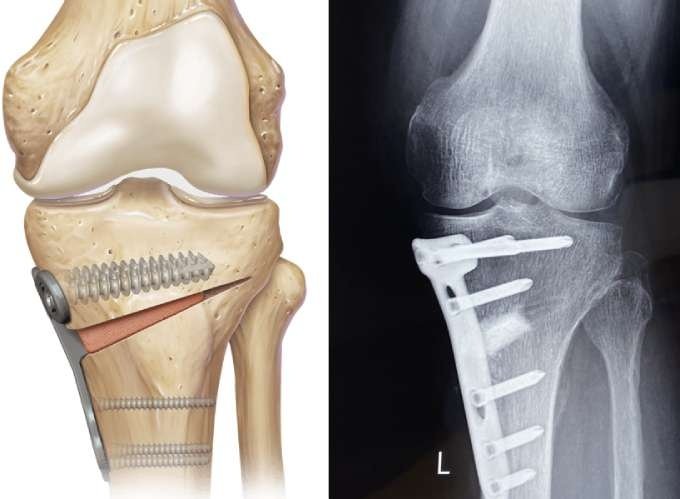
High Tibial Osteotomy is a joint-preserving surgical procedure used to correct abnormal alignment of the knee by realigning the upper portion of the shinbone (tibia).
It is most commonly performed in patients with bow-legged alignment (varus deformity), particularly when arthritis or cartilage damage predominantly affects the inner compartment of the knee.
During surgery, the tibia is carefully cut and realigned using an opening-wedge or closing
wedge technique. The corrected position is generally secured using a specialised plate and screws.By correcting the mechanical alignment of the lower limb, the procedure aims to redistribute weight away from the damaged compartment, reduce pain, improve knee function, and potentially delay the need for joint replacement.
High tibial osteotomy may also be considered for selected deformities and ligament-related conditions where correcting the underlying alignment is important.
Distal Femoral Osteotomy (DFO)
Distal Femoral Osteotomy is a joint-preserving surgical procedure used to correct abnormal alignment of the lower portion of the thighbone (femur), close to the knee joint.
It is commonly performed in patients with knock
knee alignment (valgus deformity), particularly when excessive loading causes pain or cartilage damage in the outer compartment of the knee.During surgery, the lower femur is carefully realigned using an appropriate osteotomy technique, and the corrected position is typically stabilised using a plate and screws.
The procedure aims to restore appropriate lower
limb alignment, redistribute joint loading, reduce pain, and preserve the natural knee joint.In selected patients, distal femoral osteotomy may also be performed to correct bow-legged deformity or other alignment abnormalities originating in the femur.
The choice between tibial and femoral osteotomy depends on the location and severity of the deformity, joint condition, and individual surgical requirements. In more complex cases, correction of both the femur and tibia may be necessary.
What is Corrective Osteotomy?
A corrective osteotomy is a surgical procedure in which a bone is carefully cut and realigned to correct an abnormal angle or alignment.
The corrected bone may then be stabilised using appropriate fixation devices to allow proper healing.
Osteotomy may be considered for selected deformities of the knee, hip, leg, or other areas.
What Happens During Deformity Correction Surgery?
The surgical approach depends on the type of deformity.
Generally, the procedure may involve:
- Detailed preoperative assessment and imaging
- Careful measurement of bone and limb alignment
- Planning the required correction
- Surgical correction of the abnormal bone or joint alignment
- Stabilisation using appropriate fixation when required
- Assessment of the corrected alignment
- Closure and postoperative monitoring
- Growth modulation surgeries in small kids and adolescents to control the deformity.
Advanced planning is particularly important in complex deformity correction procedures.
Recovery After Deformity Correction
Recovery depends on the type of deformity, surgical technique, bone healing, and the patient’s overall health.
Postoperative care may include:
- Pain management
- Wound care
- Physiotherapy
- Gradual movement and strengthening
- Weight-bearing restrictions when required
- Use of walking aids during early recovery
- Follow-up imaging
- Monitoring of bone healing
Patients should follow their surgeon’s instructions regarding activity and weight-bearing during recovery.
Rehabilitation After Deformity Correction
Physiotherapy may help patients:
- Restore joint movement
- Improve muscle strength
- Improve balance and coordination
- Develop a better walking pattern
- Gradually return to daily activities
- Improve overall limb function
The rehabilitation programme is personalised according to the procedure and individual recovery.
Benefits of Deformity Correction
Depending on the underlying condition, treatment may help:
- Improve limb and joint alignment
- Reduce pain
- Improve walking ability
- Restore functional movement
- Improve joint stability
- Reduce abnormal stress on joints
- Improve daily activity performance
- Address progressive deformity
Treatment outcomes vary depending on the cause and severity of the deformity and the patient’s overall condition.
Who May Benefit from Deformity Correction?
Deformity correction may be considered for patients with:
- Significant limb or joint malalignment
- Pain associated with abnormal alignment
- Deformity following a fracture
- Progressive joint deformity
- Functional difficulty while walking or performing daily activities
- Limb length or angular abnormalities
- Deformities that affect joint function
A detailed orthopaedic evaluation is necessary before deciding on the appropriate treatment.
Why Consult an Orthopaedic Specialist?
Deformity correction requires accurate assessment of bone and joint alignment and careful treatment planning. An orthopaedic specialist can evaluate the underlying cause, assess the severity of the deformity, and recommend appropriate surgical or non-surgical treatment options.
If an orthopaedic deformity is affecting your movement, comfort, or daily activities, seek a specialist evaluation to understand the available treatment options.
Experiencing pain, abnormal alignment, or difficulty walking? Schedule an orthopaedic consultation for a detailed evaluation and personalised treatment plan.
Hear From Our Happy Patients
Read genuine patient experiences and feedback about Dr. Dhruva Angachekar’s compassionate care, orthopedic expertise, and commitment to patient recovery.
EXCELLENT Based on 6 reviews
 Posted on Google

 Smita BhateDr. Dhruva Angachekar helped me resolve a few chronic issues I suffered , pain and restriction in movement and some regular activities. My shoulder blade had stabbing pain , my glute was very painful and hip mobility was compromised, some knee pain too. He assessed my overall mobility, condition and put me onto a specialised sports performance physiotherapist, to realign my kinetic chain , as he had explained to me. It took some months of rehabilitation, but for the 1st time , I got relief without medication and my mobility improved drastically and for good I was extremely happy for the specific recommendations he had advised the sports physiotherapist about, which eventually resolved so many simultaneous issues . I highly recommend him as an Orthopaedic doctor for Sports Injury and he is a Joint Replacement specialist too.Posted on Google
 pradnya jadhavExcellent experience ! Had visited Dr. Dhruv for knee pain and a possible hand fracture! Guided us well through the treatment.Posted on Google
 Prabhash SinghDr Dhruva Angachekar recommended for best orthopedic and sports injury surgeon in Mumbai.Posted on Google
 Antesh AnandHighly recommended orthopedic and sports injury surgeon in Mumbai
Frequently Asked Questions
Both procedures aim to correct abnormal lower limb alignment while preserving the natural knee joint.
High Tibial Osteotomy (HTO) corrects deformity involving the upper shinbone and is commonly used for bow-legged alignment.
Distal Femoral Osteotomy (DFO) corrects deformity involving the lower thighbone and is commonly used for knock-knee alignment.
Your surgeon will assess the location of the deformity using clinical examination and full length standing X-rays before recommending the appropriate procedure.
In appropriately selected patients, corrective osteotomy may delay the need for knee replacement by several years.
By improving limb alignment and redistributing forces across the knee, osteotomy can reduce excessive loading on damaged joint surfaces while preserving the natural joint.
However, it does not reverse established arthritis or guarantee that joint replacement will never be required.
There is no single age limit applicable to every deformity correction procedure. Suitability depends on the type of deformity, cartilage condition, bone quality, overall health, and functional requirements.
Joint-preserving osteotomies are often considered in younger, active patients, although selected older individuals may also benefit.
Your surgeon will evaluate whether deformity correction or another treatment is more appropriate.
Recovery varies depending on the bone involved, extent of correction, fixation technique, and individual healing.
Most patients begin assisted mobilisation shortly after surgery, although weight-bearing may be restricted for approximately 6–8 weeks or longer depending on the procedure.
Bone healing and progressive strengthening take several months. Many patients gradually resume routine activities within 3–6 months, while demanding physical activities and sports may require 6–12 months or longer.
Your surgeon will guide rehabilitation according to clinical and radiological healing.
Most patients begin standing and walking with crutches or a walker shortly after surgery, depending on the procedure.
However, full weight-bearing may not be permitted immediately, as the corrected bone requires time to heal.
Your surgeon will advise you regarding walking aids, weight-bearing restrictions, and progression towards independent walking based on follow-up X-rays and recovery.
Yes. Osteotomy may be particularly beneficial when arthritis predominantly affects one compartment of the knee and abnormal alignment contributes to excessive joint loading.
By redistributing forces towards a healthier part of the joint, the procedure may relieve symptoms and preserve natural knee function.
However, patients with advanced arthritis affecting multiple compartments may be better suited to joint replacement.
Yes. Both bow-legged (varus) and knock-kneed (valgus) deformities can be corrected using appropriate surgical techniques.
Depending on the location and severity of the deformity, surgery may involve the tibia, femur, or both bones.
The aim is to restore appropriate mechanical alignment while preserving joint function and avoiding unnecessary stress on the surrounding structures.
Not necessarily. The plates and screws used to maintain the corrected bone alignment can often remain in place permanently.
However, implant removal may be considered if the hardware causes persistent irritation, discomfort, or other complications after the bone has healed.
Routine implant removal is not required for every patient. Your surgeon will assess whether removal is necessary.
As with any orthopaedic procedure, corrective osteotomy carries certain risks, including infection, blood clots, nerve or blood vessel injury, stiffness, delayed bone healing, nonunion, implant irritation, and undercorrection or overcorrection of the deformity.
Some patients may require further surgery, and symptoms may persist despite successful alignment correction.
Your surgeon will discuss the expected benefits, potential risks, and recovery requirements before recommending surgery.
Neither procedure is suitable for every patient.
Deformity correction surgery aims to preserve the natural knee by improving alignment and redistributing joint loading. It is often considered in selected patients with localised arthritis or correctable mechanical abnormalities.
Knee replacement is generally considered when advanced joint damage causes persistent pain and functional limitations despite appropriate treatment.
Your surgeon will evaluate your symptoms, joint condition, imaging findings, and activity requirements to recommend the most appropriate procedure.
Yes. Some patients have deformities involving both the femur and tibia, or a combination of angular and rotational abnormalities.
In these cases, correcting only one bone may not adequately restore normal limb alignment.
Combined or multi-level osteotomies may be recommended in selected patients to achieve appropriate alignment while maintaining normal joint orientation and function.
A detailed clinical evaluation and full-length standing radiographs are important for planning these procedures.
Connect With Us
Email Address :
ortho.paramount@gmail.com
Location Address :
Sakinaka Junction, Andheri East, Mumbai – 400072
Contact No :
+91-91529 98888
Book An Appointment
Dr. Dhruva Angachekar
Consultaiton Timings:
Monday to Friday : 7:00 PM to 9:00 PM
Saturday on Appointment
Call on:
+91-91529 98888
Paramount General Hospital
Consultaiton Timings:
Monday to Friday : 7:00 PM to 9:00 PM
Saturday on Appointment
Call on:
+91-91529 98888

Specialized orthopedic care for joint replacement, sports injuries, arthroscopy, deformity correction and complex orthopaedic trauma.
OUR TREATMENT
Copyright © 2026 Dr. Dhruva Angachekar. Designed by